
Words On Fire | A Book Review

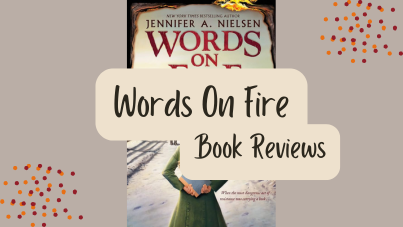
Hello, and welcome back to Blonde Girl Writing, where I talk about writing, God, and reading!
Sorry for the unexpected hiatus–my life has been super busy between working two jobs and going through the Author Conservatory. But, I’m back now, and with an all-new book review for one of my favorite historical fiction books: Words On Fire!
So, without further ado, let's get started!
Overview
Words On Fire is a fiery middle-grade historical fiction book based on the book smuggling that took place in Russian-occupied Lithuania from 1864 to 1904. It follows Audra, the daughter of two book smugglers, who is tasked with getting an important package safely delivered where it belongs after her parents are arrested by Cossack soldiers. Throughout the book, Audra struggles between doing whatever it takes to get her parents back and learning the work of book smuggling, a very selfless profession where people put their lives on the line just to bring knowledge to the Lithuanians. She also discovers the power of language and ideas and how they shape the freedom of the people who learn them.
This book is seriously one of my favorites by Jennifer A. Nielsen. It has an interesting, multifaceted girl main character, a premise based on the power of books and language (two things I am very interested in!), and stakes that make you want to keep reading until you discover the entire story. I also love historical fiction, because it’s basically stepping into the shoes of someone from history and learning about how life was lived back then, and how the events that happened changed people and even the world.
Content
This book is not recommended for anyone under the age of thirteen. While there is no adult content like gore, cursing, etc. I would describe it as a higher middle-grade read. Some of the content within includes:
Mentions of hard labor & death/getting killed
Several intense chase sequences where the characters are very scared and in danger of being arrested
Buildings get burnt down & books are burnt
Clearly painful back lashing (non-graphic)
Gun threats and getting tied up
Civilians injured/killed by soldiers’ guns (very brief mention, non-graphic)
Near-drowning
Non-graphic mentions of blood
Since this is historical fiction, there are very real depictions of fighting, killing, children getting chased, and dangerous fires. I’d consider these elements to be on par with another one of Nielsen’s books, The False Prince, or other middle-grade historical fiction novels.
Characters
The characters truly are the stars of the book, and each one feels incredibly real and full of life.
WARNING: There are minor spoilers ahead. If you haven't read Words On Fire, please proceed with caution.
My name is Audra. In my language, Lithuanian, it means storm. But my language has become illegal…So I avoided saying my name in public, but I often wondered: If my language was forbidden, then my name was forbidden. Which meant I had no name. Page 1
Of course, we have the main character, Audra, a twelve-year-old girl who lives with her parents on a farm in Lithuania. At the beginning of the book, she’s a bit juvenile and selfish, mostly out of fear for herself and her parents. She resents the books that her parents smuggled because they took her parents away from her–they are the reason her parents are arrested. However, she proves herself to be smart, clever, and very creative. The more she discovers about why her parents cared so much about the books, learns to read and write, and is sucked into the dangerous world of book smuggling, the more she grows and changes. She learns how to be defiant and stand up for what she believes in, learns how to read and even write her own stories, and begins to risk herself for a cause that, at the beginning of the book, she despised.
“In fact, the boy has never told the full truth of his life to anyone but this frog. You see, the boy has lied about himself for so long, that sometimes he forgets why he started working on Rue’s land in the first place.’ … ‘Because he understood that he had to make a choice. He had to fight the snake, or one day he might become the snake.” Pages 136-137
Lukas is the secondary character, and a great one at that. While he has a mostly flat character arc, he is the truth character that Audra needs throughout the book. He is brave and willing to do whatever it takes to put books in the hands of the Lithuanian people. He is self-assured and has confidence in his abilities as well as the people around him. He is a smart book smuggler and someone who brings a bit of levity to an otherwise solemn task. He is not without his faults, however–he is overly eager to risk his life, and sometimes that gets him into trouble. He is also stubborn and headstrong.
“...He banned the idea of Lithuania. We were all to become Russian. To speak like Russians, and especially, to think like Russians. Lithuania was to be erased from the map.’ … ‘How do you destroy a people? You take away their culture. And how is that done? You must take their language, their history, their very identity…” Page 78
“Smuggling is a crime,’ Ben countered. ‘Carrying is noble.” Page 99
Then there are Milda and Ben, the two main adult characters. Milda is a book smuggler who runs a secret bookshop and school out of the basement of her home. Ben is also a book smuggler, but one who gets in on the action by crossing the border between Lithuania and Prussia, taking books from printers in Prussia willing to print illegal Lithuanian books and bringing them to book smugglers so they can get them to the people. Milda is more of a kindly grandmother figure, and a mentor to Audra as she learns the ways of book smuggling, and is endlessly creative in both her disguises and the ways she gets books to the Lithuanian people. Ben is a cranky old man, but with a secret heart of gold, and while his overprotectiveness often clashes with Audra and Lukas’s adventurous spirits, it’s only because he cares about them.
“Perhaps all of Lithuania is a fairy tale! An imagined place that refuses to acknowledge its position in the real world!” Rusakov shouted. … ‘...Freedom is never given as a gift; if you want it, then people will die for it. Why can’t you just accept the occupation and live in peace with us?” ~ Pages 298-299
There’s also the main antagonist–besides the Russian Cossack soldiers, of course–namely, Officer Rusakov. He is ruthless in pursuing Audra throughout the entire book, and will stop at nothing to get what he wants. He threatens people, sets villages on fire, and even alienates his family, all for the sake of trying to stop one little girl from book smuggling. He does grow a bit by the end of the book, but for the most part, he’s the reason for conflict in the story.
There are other minor characters that Audra and Lukas meet on their journeys, my favorite being Roze, a little girl who lives in Milda’s village and attends Milda’s secret school. They really round out the world and make it feel real, bringing their own personalities to the table despite having little page time.
All in all, I love the characters in this book. Nielsen definitely knows how to craft them well.
Plot
The plot throughout the book is engaging and what I would certainly call a “page turner.” There’s enough action that reading never becomes dull, but enough slower, simpler scenes interspersed between that you never feel like things are moving too fast.
The book mainly follows Audra and her development from someone who just wanted to deliver her package and be done with the whole thing to a girl with a passion for reading and writing who is willing to risk everything to bring books to her people in their language. The beginning of the book is about Audra bringing the package to Milda, the middle focuses on her development as she stays with Milda and slowly discovers why the book smugglers do what they do, leading to her being trained in the ways of book smuggling. After that, the rest of the book is mostly Audra and Lukas delivering books across Lithuania, later crossing the border between Lithuania and Prussia several times before Audra eventually settles down in Prussia with Milda for good.
The book is a total of 322 pages long, which leaves plenty of room for plot as well as slower moments that develop the characters and their relationships with one another. It feels like so much happens in a relatively shorter book, but Nielsen managed to fit it all in and still have it be cohesive and interesting!
End of minor spoilers.
Theme
Personally, I believe that the theme of Words On Fire is about learning to be brave and the power of the written word.
The main character arc Audra goes through is sparked by her growing desire to learn–whether that’s learning how to read Lithuanian, write her own words, or smuggle books. She discovers that no matter how many book smugglers the Cossacks kill, the point of everything is in the books and the language they are written in, and that as long as the Lithuanian language stays alive, the book smugglers’ work will, too. The written word leads to ideas and thoughts, which are shared from person to person, taking on a life of their own that no gun or fire can destroy. Censorship is the death of freedom–and while I believe there should be a base minimum requirement for what is acceptable to read, especially for children, destroying ideas that we don’t personally agree with is how we destroy cultures and take away the voices of the people.
Audra also learns how to be brave throughout the course of the book. As she grows more confident in her skills as well as the cause of book smuggling that she lives for, she is able to speak with and even fight against the Cossack soldiers. She faces danger at every turn–fire, arrest, drowning–but continues to smuggle books because she believes that they are important and worthy of sacrificing everything for.
While Words On Fire is not a Christian book, I can relate to Audra finding a cause to believe in and give up everything for. I believe in Jesus and how He has saved me, just as Audra believes that the written word can save her people from being completely destroyed by Russia. Both of our beliefs make us brave.
These themes are powerful and important even in modern times. They had books back then, and we still have them now. They are important vessels of creativity, ideas, and knowledge that we share with each other, and to destroy them would be to destroy a key communication between human beings. Being brave is also important, because in a world where things are looking darker and darker every day, having something to believe in and stand up for can bring hope and even bring people together.
Final Thoughts
Words On Fire is an amazing historical fiction book with themes that still relate to us in the modern day. It uses three-dimensional characters who grow and change throughout the book to communicate themes of bravery and the importance of the written word without stuffing them down your throat or making them blatantly obvious. And the plot is action-packed but in a way that makes the slower moments even more important, telling a complete story in a good amount of time.
If you need something to read, I highly recommend Words On Fire. It’s perfect for anyone who loves books, history, or even just an exciting adventure book that’s more real and raw than you might realize. Just beware the more intense content within, and save it for children 13 years or older, just to be safe. In the end, Words On Fire gets 4 out of 5 stars from me.

Thank you for reading, friend! I hope you enjoyed this book review.
Let me know below: What did you think of my review? Have you read this book, and if so, what did you think? What book should I do a review for next?
Best wishes,
Jonah


Comments